Wednesday, February 23, 2022

Melvin & Me, Part 35: How I'm an Accidental Prude

This is going to be one of those cards-on-the-table ones, I think, with some raw stretches that feel maudlin to write but are somehow also true.  Sometimes, I feel I wear my mental health struggles a little too well, which means that I do have to talk about them directly, particularly the places that are hard.  

There are moments at work where we can simply be human, where we can talk about whatever is real to us outside of the fifth floor.  There are spaces to joke and just be people.  One day, someone at the desk asked, "what's that smell?"

Another peer piped up with a glib response:  "Oh, Larissa farted."

I froze inside for just a split second.  There was a spike of panic in my heart, that perhaps my ostomy bag was leaking.  This was quickly dismissed--I knew it was just a silly joke.  Truly something harmless.  And yet.  That panic was real.  There was also a cold emptiness that followed the exit of the panic.  This wasn't a joke I could actually participate in.  Hell, I've had whole existential crises trying to figure out how farting applies to someone with an ostomy.  

I clarified immediately, pulling a face and stating, "Mmm, I don't do body humor."

Naturally, that required some clarification, that I don't participate in body humor because it hits differently with the ostomy and all of the sordid history that I carry.  But my summary was much shorter and the apology was immediate.  I clarified that I'm never mad at someone for not knowing about the ostomy or my preferences in how I discuss it or allude to it, but I would be upset at someone that crossed a boundary that I had deliberately set.  

Lately, there had been two other moments where the group was feeding into a conversation about bodily functions.  "Farts that itch the butthole the one way out," or discussions on along that end of things, a full ten-minute discussion about bodily functions.  This was something that was supposed to be relatable to everyone.  Connecting and humanizing.  

But not me.  With the colostomy, I have no control on what releases when nor do I have an anus anymore--just a memory of what it was once like to have such sensations and worries, exchanged for new ones that most people simply cannot relate to, just a subsect of us.  Know what it's like to have your stomach rumble in a quiet but populated room?  Make the sound wetter and louder...and then normal.  

The longer the conversation went, the more isolated I felt.  I could not connect to the basic experience of, well, sharting or finding a particular place to fart or a number of basic things.  I nodded along, but I had absolutely nothing that I could contribute to that conversation.  It may as well have been in another language.  I felt hollow.  And distant.  Othered.  Quietly hurting behind a mask in a conversation that was intended to build community.  

I thought about it after the fact, wondering if I should have said something to jar the conversation away or bring in my unique take on it, but that wasn't what I wanted.  I'm still not sure what I would want, but I know that I didn't want that, didn't want to just make it about me.  Similarly, I definitely don't want others attempting to point out "well, except Larissa" and then go on a tangent there because pointing out the exclusion can make it worse, particularly when it's by name--a vague mention, maybe, but not a direct one.  In this moment, though, I wanted the rest of the group to have their space, too:  I just didn't know how to be part of it.  

This extends to sex talk.  I don't trust my body.  I have no reason to trust my body, for as much as I have been betrayed by it.  Trusting someone else with it is harder still.  This means talking about sexual experiences and fantasies fall into a similar camp--my brain says it's not safe, equating arousal with danger, since it's all a part of the sympathetic nervous system, such is the joy of PTSD in my case (a bit more on that here).

So the result is I don't engage.  Or if I do, it's only in small doses, because, confusingly enough, sometimes it's completely fine and I don't mind being proxy to the conversation at all--I have yet to figure out the pattern.  And the result on the outside is that I am accidently a bit of a prude.  Not because I think the subject matter is improper or wrong, but because I genuinely cannot engage with it, for the swallowing ache of PTSD.  I am activated, my sympathetic nervous system screaming that I am profoundly unsafe, recalling complicated grief. 

I can't pinpoint what I need in those moments; I can't even identify what I would want said to me.  It's just a moment when the grief surprises me, where a wave rolls up and smacks into me on an otherwise clear day.  The situation is not predictable enough that I can censure anyone or any specific topic--but I have drawn occasional lines ("That's enough") in individual situations.  I feel so obviously broken in those moments, but I would say the bulk of them are wholly under the radar.  Again, I don't necessarily want the conversation to stop just to check in, but in the same breath, that widens the disconnect all the more.  In those overthinking spaces afterwards, though, I do wonder if that is misconstrued, that not engaging means I may be more likely to be excluded from certain conversations or left out of an invitation to play Cards Against Humanity.  

This particular grief stems from a feeling of disconnection, disconnection from "normal" body function, assumptions of the world, accepted ideas of security, perceptions of how the body can be used and enjoyed, and even a disconnection from the sense of self that I used to have.  This grief is a process, another space where radical reacceptance of my situation is needed daily, hourly.  Even as I continue to find good avenues for processing, there will always be spaces that require extra attention--extra energy--than I may have expected for a situation.  

Again, I have nothing actionable to share, no requests for future changes or subject avoidances specifically.  If anything, perhaps a generic "don't assume my motives," at most.  This was more a means to explore and name these feelings, to name another place where my disability has irreparably changed a part of my identity.  Ignoring pain delays healing; labeling the disconnection breathes new understanding; and in the meanwhile, I find my safe spaces to process, titrating peace in chewable increments.

Wednesday, February 16, 2022

Peterson Family Update, #53401-12A Tau

 What, ho!  It's time for another bulleted list!

  • So, the Rivian R1T is absolutely brilliant in snowy weather.  We went to drop off the Volt at the dealership to get checked out on Wednesday morning of the big snow, and it did not care about any of the drifts or whatever else.  Having all of that power instantly, a motor on each wheel, and a low center of gravity, it was unbothered by whatever weirdness was thrown at it.  So we weathered the snowmageddon pretty cleanly.  
  • Andy also was excited to participate in a time-honored tradition of owning a pickup truck:  helping a friend move.  He's been delighted to share and answer questions and, yes, he has an Instagram specifically for Tutti.  
  • Luna was less thrilled about the snow but did decently well with it anyway, a healthy bit of confused at all the stuff but figured out how to pee again eventually, out of desperation if nothing else.  Sometimes when we go on walks we reenact scenes from Bambi, but she's still happy to go outside.
  • I'm getting back in the pool once more, and swimming my last mile I was contemplating how there has to be a fair bit of grace in the movement, each stroke flowing with the water.  Once again, mindfulness of my body in space and how that correlated with the success of the pull, how my energy dissipated into each kick, it made for some quick laps.  
  • Mike got a kick-ass new tattoo, and is already planning on the next.
  • We got a few new boardgames lately, which has involved some collective, constructive arguing over rule interpretation as we try to figure it out together.  A few names to pull out:  Doomlings, Killbots, and The Lost Ruins of Arnak.  The latter has been particularly interesting.  Major game mechanics heavily features resource gathering and, oddly enough, deck building--research can be fun and very rewarding!  And so can exploring unknown territories.  And fighting monsters.  It's scoring reminds me of Seven Wonders, and turning resources into advancements works like Settlers of Catan.  

Plus, the theming is a heap of fun--still better archeology than Indiana Jones
  • Work has been six kinds of nutty, with not only patients racking up the Covid count, but a handful of nurses out for various reasons (vacations, life, etc.).  Staffing continues to be...tricky:  the hospital is FULL.  As soon as one patient leaves, housekeeping rolls right in, and we start working on another admission.  Keep moving; keep running; keep breathing.  And yet, while the busy is a certain flavor of exhausting, it still feels as though I'm in the right place.  More and more, I feel that I'm meshing into my team, feeling more that my unique presence is appreciated and not just having more hands around.  I'm still learning a lot.  I'm getting better at other things.  I'm asking a lot of questions.  
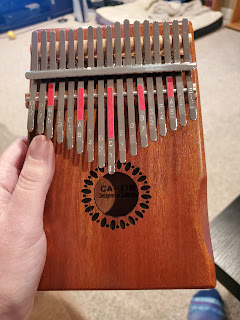
  • I made an impulse buy the other day.  I bought a Kalimba (picture below).  It's a small hand piano, a box that fits comfortably in both hands that I use my thumbs to make gentle cords and sounds.  I've found it quite soothing--it's like making my own meditation soundtrack.  I'll figure out how to get a video of it in a future blog at some point.  
  • Starting to look toward using some vacation time for, well, actual vacations.  Got a plan to go on a roadtrip to see some friends in March and a family vacation in May that is starting to take shape.  I had forgotten how much I can enjoy planning trips, even small ones.  Andy and I are set to hit our ten-year anniversary in May--we have not ruled out a larger trip at the end of the year, maybe Iceland, to celebrate as we are not strict in our household on celebrating on the "correct" day.  We'll, of course, have to see what the situation with Covid is at that time, since we are continuing to be cautious in this household as we cannot afford to do otherwise.
  • It's good to find something resembling a rhythm again after the holidays.

Wednesday, February 9, 2022

Fledgling Nurse, Part 7: When to Flex

I knew getting into nursing was going to have a specific kind of baggage, and it was during nursing school that I began to see the first few signs of it:  friends and family asking for medical advice.  

It was inevitable.  Some of the questions I redirected to Dr. Google--when it's specific side effects of a particular medication, I do not have a complete compendium of these in my head as of yet though some important generalities are firmly lodged in place, such as NSAIDs and gastric bleeding.  Other questions that are more general knowledge or things that I took for granted as general knowledge, though, I've answered a number of these.  I had only completed my program by a couple of days when I received a call from a family member asking whether they should go to the emergency room (after gathering a bit of information, I suggested PromptCare if X and Y did not improve by Z or go to the ED if there were life-threatening symptoms like trouble breathing).  I've had a couple other friends ask, receive permission, and then send me pictures of different parts of their body.  I've looked at weird skin spots.  I've explained the mechanism of action of various medications.  I've explained what to expect as a loved one regresses further into dementia.  I've re-explained procedures that were only half understood after doctors' appointments setting them up.  These and more, I understood that the questions were inevitably part of the territory.  

As happy as I am to help, I am more cheerfully helpful when persons check for permission first.  It's an important boundary check.  However, I won't deny that I am happy to teach where I can teach.  I like sharing the information I know, to flex those pieces of knowledge to help someone else (while still adding the caveats that I'm not a replacement for keeping their doctor appointment).  

And that has to go in reverse, too:  I have to check before I jump in with unrequested information.  Sometimes someone is just venting and not asking for medical advice.  There have been conversations where a loved one was hospitalized or diagnosed with some kind of condition and it's as though the password was spoken and my empathy is overshadowed by overwhelming curiosity.  I want to ask what medications have been tried, have they approached the topic of X or Y therapy, what were the last lab results on Z, have they also experienced Q symptoms, etc.  I have to stop myself, though, when I realize that my curiosity is not necessarily productive to the conversation.  I have to know when to flex the knowledge that I have.  

This can get especially tricky when I'm at work.  When I'm clocked in, I have given implicit permission to be asked medical related questions.  Hell, we have set reminders to chart education, meaning that I am expected to offer it at the very least daily, not just the information dump before discharge.  But the family member who just signed their loved one into hospice, they aren't interested in how the body will mechanically deteriorate at the moment--their questions of "when are they going to die?" are more about coordinating with the family and finding their own processing space.  Factual and practical information could be soothing or it could induce more anxiety.  Or more confusingly, there can be a balance of information that is helpful before tipping over from empowering to overwhelming.  

There isn't a magic formula to know how much information is too much--it involves a fair bit of guessing and gentle prodding.  I try to ask questions along the way to ensure that the party is open to information or otherwise start with where their questions are, titrating information in pieces as I see them throughout the day.  One of my favorite questions especially during discharge instructions is "I just threw a lot of information at you:  what can I clarify?"  This firstly acknowledges and validates any feeling of overwhelm.  It's also an open-ended question, meaning that there isn't a space for a simple, placating yes or no.  Sometimes we cover the same information again; sometimes we're taking it a step further.  I try to also end with a brief "if you remember anything from what I just told you, remember these three things," in order to bring to the forefront one more repetition as the final say.  

Outside of work, though, there are spaces where the information I have learned is helpful and places where it is not.  There are places where people demand it and places where forget that that experience can be a resource.  This means putting out feelers for what is welcome without overstepping.  It's the same process in offering any expertise, that balance between the excitement of knowing the answer and the awareness that "an answer" still may not be what the conversation partner needs in the moment.  I've learned how to ask the questions that are indirect, probing for what someone might want from the conversation, but this still entails more guessing than I would prefer:  as such, I'm growing more comfortable with directness.  I asked a patient the other day, "Would you like to understand or do you just need to vent?"  I've asked many times "How can I help you best?" whether I'm listening or helping someone with a task.  At home, we are learning "That's not helpful right now," when someone is trying to fix something that we only needed a listening ear for.  Sometimes whole conversations are preceded with a phrase or question to help indicate whether listening or problem solving is the goal--85% of the time, I feel, it's listening.  

Sometimes I think I know someone or a particular inflection well enough to guess whether they want input or a listening ear, yet I've learned that it's okay to check even midway through, confirm those thoughts before there is accidental overstep.  My knowledge base in my field will continue to grow, and I will actively be ensuring that my communication skills--particularly checking for consent and boundaries--sharpen along with it.  

Wednesday, February 2, 2022

Feelings of Time

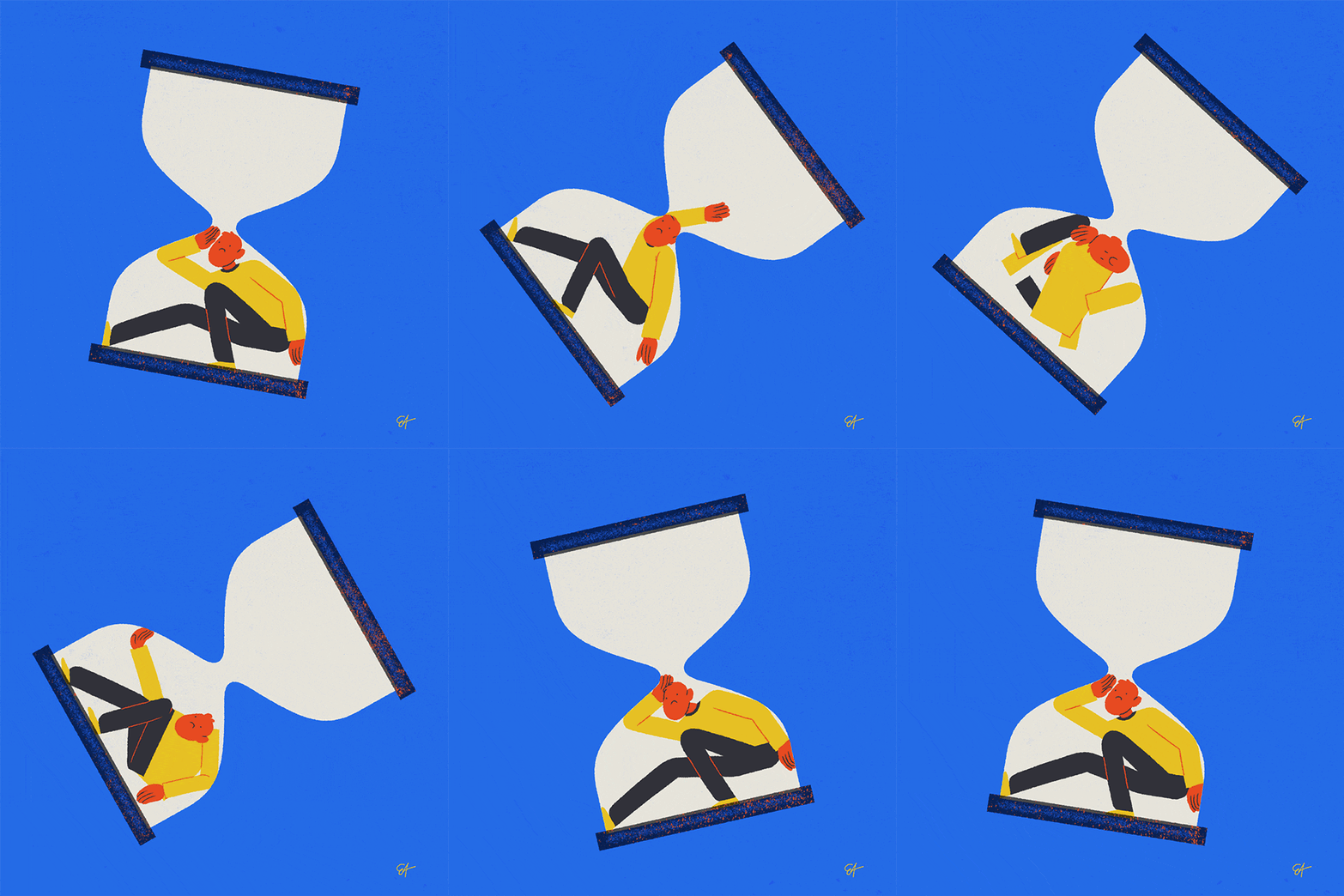
There's always something odd to me in those days between Christmas and New Years, the days between when Santa is measuring goodness and before resolutions actually start.  Time doesn't seem to make sense on these days.  In my mind's eye, I see it as a strange void in the calendar, to the degree that each time I land on those days I find myself surprised that they're there.  

Of course, this could be due in some large part to the schedule shifts and pressures of the holiday season.  The first couple weeks of January seem to linger in an odd refractory period.  This is compounded by two things:  the general stress of trying to reacquaint with routine while acknowledging the positive and negative toll of the season and the pressure this time of year to generate new, healthy habits as New Years' Resolutions.  In other words, there is a recovery period where extra energy is needed there on top of the "normal" load itself, still while attempting to carve out new spaces.  It makes for some interesting emotional work.  

I've heard before that it takes about thirty days for something to become a habit.  I cannot say whether this is true specifically on the psychology angle, but at least in my own personal experience that seems about right.  I have been looking at restarting my meditation app, where it has been encouraging me to find the same time every day to do X or a keto restart book that states out every meal for about a month...and all the enthusiasm drains away.  I don't have the kind of schedule anymore that allows for routine.

I work a twelve-hour shift, in a twenty-four-hour field.  The work is never over.  That's become a new mantra in some places for me:  "The work is not over; it's time to stop."  I'm not going to be able to "fix" any of my patients, but I am able to contribute to their success in small increments at a time.  There are certain tasks that must be done every shift, either at a specific time or to be completed by the end of shift, but when they happen in the day, well, there is no pattern.  I try to get at least two patient assessments done before we all meet with the charge nurse at 0800, and then it's off in the flurry of 0900 med pass, completing the subsequent assessments in the morning and working through the huge push of morning medications, all the while my phone seldom stops ringing with patient call lights, doctors' responses, family members wanting an update, a deluge of staff communication, and all else.  The best thing to do is find a way to bend to the most immediate needs and set boundaries or expectations in others (e.g. "I am in another patient's room at the moment" or "I can call back in about an hour"), because, no, I'm not going to leave the patient who has suddenly dropped in blood pressure to bring someone else a glass of water.  There are too many places I need to be at once, which means I have to make some choices.  As such, there is no daily work routine, only outlines.  Usually, I eat lunch somewhere between 1130 and 1530.  I chart in the gaps.  I go home and unpack and jump into the shower to ensure I don't share anything more than I have to with my housemates.  Decompress a bit or set everything up for the next day or start some laundry or whatever else.  Wander to bed sometime between 2000 and 2300.  

So about creating rituals or routine, my workdays are not conducive to that.  And subsequently, my workweeks are also not conducive to finding a daily pattern:  I work three days a week, and which days those are varies by week.  My housemates and I have to meet weekly to talk about groceries (which alternates to different days) and discuss who is cooking when.  We want to establish some better habits for Luna--I cannot commit to specific days because my days move.  Which days I am going to swim changes by week.  When I schedule time to reconnect with family and friends varies.  Weekends don't feel like weekends anymore.  This means I'm out of sync with a lot of the assumptions in the world--when people talk about Mondays, there is no sting of dread in quite the same way.  There is no daily pattern, and there is no weekly pattern.

And somewhere it clicked that I do have rituals and routines, just that they are different now.  There are small habits and rituals that can be grown, and there are larger pieces that can be done on an "X times a week" basis rather than a daily or "every Tuesday" kind of pattern.  It doesn't have to be a set time every day or every week to still be a valid change for myself.  I have a particular workflow in how I perform a patient assessment and how I gear up at the beginning of a shift.  And that isn't nothing.  

The pattern is either in small details or in broader swaths--I have to change how I think about time and how I balance my various needs of it.  Even on workdays and how I think of them, time moves differently on those days than it does on non-workdays because a twenty-four-hour field moves...differently.  There is an odd reframing that has to happen after a couple of days, where the work "stops" (or at least "waits") in the bulk of other jobs.  There is no closing--resting and restocking is a deliberate act of pausing and sharing the narrative and tasks to the next body to continue the work.  

In other words, there are some of those same kinds of spaces where time does not feel right.  And it's simply not going to find patterns that I'm used to--so it's time to rethink that expectation.

Wednesday, January 26, 2022

Non-Vaccination and Ableism or How I am Excluded from Attending my Grandmother's Funeral

So, my grandmother died this last weekend.  She was on hospice; it was expected.  Yet there is still some processing to be had.  I cannot go to her funeral.  I have been excluded from her funeral.  I am furious and heart-sore.  

Here's how that happened:  there are members of my family that are not vaccinated.  While enforcing their "right to choose" to not get vaccinated for whatever individual purpose, they might be very focused on their own intentions, but there is an unmentioned impact.  I've heard it repeated that it doesn't hurt anyone else.  And yet, here we are with a clear example.   

I'm immunocompromised.  I have to protect myself.  By choosing to not be vaccinated, that means that they are refusing to make accommodations that respect that need.  It's the same energy as if I were wheelchair bound and asked if I'm going rock climbing with the rest of the family and then to be told that the choice not to go was purely my decision.  The conditions were inhospitable for my needs and then the implication is that I also am the only one to shoulder the blame.  This is ableism.  And there is real hurt here, inflicted by members of my extended family.

So, no, no one has outright told me that I'm not welcome, but their actions have.  If there are no ramps or even handrails on the steps, we exclude structurally without outright saying anything.  If there are no options to meet different dietary needs, we exclude persons from the meal and the community of that space.  If we don't take active steps to protect people with weakened immune systems, then we exclude them from those spaces.  

There is a ground assumption that "my" needs are the same as everyone else's in this way of thinking--when this assumption is then enacted out, this is ableism.  Logically we can recognize that individual needs vary, but there are still parts where signs of this thinking are so firmly entrenched in our surroundings that we don't realize it, until we try to fit a wheelchair through the doorway of a tiny bathroom or try to stand back up and have nothing to grab on to.  If it is "too much work" or "it's too inconvenient" or even "too expensive" to meet someone's needs, then there is a clear signal here that that individual simply isn't welcome.  Eventually, when we exclude those different voices for enough time, those remaining continue to reinforce their version of "normal" and then adjusting to include people again becomes all that much harder.  

We live in a collective society, where all of our decisions impact others around us.  I could make many, many excuses about how inconvenient it is to stop at a red light, but I have agreed to sign that societal contract, which not only protects me but helps protect other people.  Vaccinations are the same--maybe we won't see the personal benefit to ourselves, but we will also not have a six-car collision in our rear-view mirror.  

The decision to get the vaccine and the booster is about community health more than it is about individual health.  It is about seeing people and their needs.  It is about inclusion.  It is an expression of love to other people.  Whatever the specific intention is behind the choice to not be vaccinated, there is a profound impact of silent casualties--missing voices, broken relationships, the cumulative weight of guilting, and, yes, spreading disease and then deflecting the blame around to someone else.  The impact is there, even if one's intentions don't think it should be.  It is there.

I will not bear the risk of spreading Covid to my patients that are already ill and the impossible guilt that would follow.  I will not--after fighting impossibly hard for my current state of health--put my body at risk of developing temporary or long-term issues.  My feelings of frustration and anger in watching others choose to invalidate these concerns are wholly valid.  

I do not shake my fist at some generic idea of Covid; I openly distrust persons who choose not to care about other people, who (amongst other injuries) have denied me the sense of closure that I could have had in going to a funeral.  I am one of many in the last few years that has had to face such a quandary, weighing the emotional, physical, spiritual, and safety needs of situations and gatherings.  

The impact of individual decisions not to vaccinate prolong the crisis, continue to hurt, continue to harm.  Why refusing to not be vaccinated is a hill to (sometimes literally) die on continues to confound me.  At what point is the cost too much?  Is this a cause so worth the pain it is inflicting?  The best-case scenario is that persons who choose not to vaccinate are hurting others out of ignorance.  But that doesn't make the impact go away.  The not-so-good-case scenario is that those persons know they're hurting others and don't care.  If the point I want someone to understand is that they should simply give a damn about other people, I walk away from the unproductive argument.  In other words, I am hoping that the bulk of people that are unvaccinated are ignorant to the broader harms, that maybe I can put words to the trickier parts to process or be a face of a faceless "other."  

Because I feel unseen.  Because I feel unheard.  Because I feel invalidated by the apathy.  And because I know that I am worth more than that, and I know that I am one of many in a screaming chorus of similar hurt.  We are here.  We rail against the idea that it didn't hurt anyone else.  

Wednesday, January 19, 2022

Measuring Stick

I had an important interaction with a patient a while back.  They were bemoaning their current condition, upset that they had experienced a setback in their health.  They mentioned how they were trying to "eat better" and "take better care of [their] health" but it didn't seem to be doing anything.  

So I asked a simple question:  "How are you measuring that?"

They paused.  Noticeably chewed on the question.  "What do you mean?"

I explained that "better" didn't mean much.  What does better look like?  How could they tell if they were actually making any progress?  And they were quiet again.  

And then I went on to explain a little further:  If I say that I am trying to lose weight, I could get very disheartened by only gauging my success by what I see on the scale.  But if I consider how my clothes are fitting, that my resting heartrate is lowering, measuring certain areas of my body, noting how much less huffing and puffing there is after my cardio warm-up, the amount of weight I can lift, now I suddenly have many ways to gauge how well I am progressing.  These will ultimately be more encouraging to me and validate the progress I have made in the same breath.  In my particular case, I have lost forty pounds in a month before when my Crohn's was sixteen kinds of angry--the best BMI in my adult life I have ever been is when I was unarguably the sickest.  Subsequently, the number on the scale has not meant much to me in terms of measuring health for years.  An indicator, sure, but not the end-all, be-all, particularly compared to how much more stamina I have than I used to.  

Sometimes, we need to check our measuring sticks.  The goal cannot be something as amorphous as "better."  Creating a half-assed goal of "better" sets one up for disappointment.   It is important to set a goal that is measurable, attenable, time-based, and productive.  

Useless goal:  "Eat better."

Useful goal:  "Pack lunch for work three days out of the week;" "rotate in seasonal veggies as sides for X number of meals a week;" "decrease portion sizes by X% for five out of seven meals a week"

Useless goal:  "Smoke/Drink less"

Useful goal:  "Limit smoking to X per day; wine allotment for the week is Y glasses"

Useless goal:  "Get into a better writing schedule"

Useful goal:  "On days off, before noon, have at least a half-hour of writing time"

Another important pitfall to avoid is not starting with the end goal as the ONLY goal.  The ultimate goal for high blood pressure, for example, would be to have blood pressures consistently in a certain range, but it cannot start there, nor can the half-baked goal be all-or-nothing.  No one goes from inactive to marathon runner in one jump:  the baby steps deserve praise.  Not only that, but it can take a lofty aspiration and break it into chewable pieces.  

A diabetic could have a goal of having their blood sugar be under X amount before two out of three meals in a day, Y number of times a week.  Someone with a new blood pressure medication could set a goal of taking their medication every day for a month and another goal of going for a fifteen-minute walk three times a week.  Getting up to the chair for all three meals in a day is a brilliant goal for post-surgery recovery.  For mental health, it could be something like doing a five-minute meditation four of our seven days a week or scheduling the first therapist appointment within the month or starting each day saying three positive things about oneself or practicing a grounding exercise each time Outlook is opened to preempt a normalized panic at seeing the mountain of unreads.  Even something intangible can be translated into something meaningful--e.g. I will rate my mood of higher than three on a rubric made to help scale two days out of the week. 

It takes time and energy to frame goals well, yet the process of individualizing them to one's own ability level keeps drive for the goal in a better place and honors both the speeds and needs of the goal-setter.  Someone else's pace may not match our own needs or abilities, nor should we expect them to, even if the verbiage around New Years' Resolutions seems to oddly push specific examples and ideas as doctrine.  My goals are about being a better version of myself, not being better than someone else; it's a small but important frameshift that allows for greater freedom.  It can be helpful to have a scripted step-by-step; it can also be helpful to recognize that my personal success may not look like someone else's.  

Keep strong on those promises you've made to yourselves, my friends, even if that means finding a new way to approach them.  

Wednesday, January 5, 2022

Fledgling Nurse, Part 6: Melvin as a Superpower

So, I have had patients that needed to vent before, patients that were so caught up in what their current circumstances.  Being in the hospital is a traumatic thing, where the "normal" is broken.  And being "fine" one day and requiring to call someone to help you go to the bathroom the next does not always sit well with a lot of people.  A lot of people tend to feel very much out of control in these spaces and subconsciously try to reestablish control by making demands or picking a small fight.

Not everyone has the vocabulary to dig into what they're feeling in those spaces.  I am very intentional when I meet a patient to ask them what I may call them and often whether they would like their door open or shut--in other words, I start off by checking for consent and permission while also honoring their space and giving them a modicum of control.  I think it helps.  Giving the patient a degree of choice and autonomy in the first few moments of our interaction is what I would want at least.  

Later in conversation with the patient, while helping them to the bathroom, performing my morning assessment, or documenting all of their morning medications, I tend to see if I can get a conversation going, to understand a bit more about their situation and where they're at.  If I have caught the patient in a space where they A) trust me enough to be honest, B) are emotionally overwhelmed enough that it doesn't matter, C) seek to manipulate me in some capacity (unconsciously or otherwise), or D) some combination thereof, I might be able to tap in to how they are coping emotionally as well.  I try to make specific invitations to these places, actually.  

Every now and again, though, I get a patient that tells me that I don't understand what it's like to actually be in the hospital.  And they cannot see small tightening of my lips under my mask as I have an involuntary, rueful smile.  Then, I tell the patient, that, sure, I cannot understand exactly what they might be going through, but I have some idea, at least.  At that point, I may add in that I have had a chronic illness since I was twelve and have a permanent colostomy that I call Melvin, with a long hospitalization fresh enough that I still remember a lot of those same general feelings.  It's only ever a sentence or two, unless they start to ask about details, because I put the conversation focus right back on them--it is a vessel to validate their feelings, to acknowledge some frustrations that are real yet hitherto unnamed.  I establish my credibility and authority not only as a nurse but now as a human being that has also been in a similar space.  I might mention how inconvenient it is to twist around for the toilet paper in the bathroom, particularly if one is sore and achy or recently had abdominal surgery.  I might mention that the first time one can shower by themselves again is a glorious achievement, as is the first time farting after a surgery.  But I always come back to their current experience.  I show them briefly my authority to empathize, and then it is back to a new, deeper understanding between us.  

And often the conversation is free to dig into the real concerns that they want to talk about.  I listen, paraphrase back, add in my own ways of describing similar feelings, and continue to listen while tidying up the room a bit or occasionally doing some quick charting to allow myself to linger a moment longer.  Other times, it's clear I need to put down some distractions and either touch their shoulder gently or take their hand, offer a tissue.  

I don't always have as much time as I would like for these holy, human moments.  It does make them all the more precious.  

It's odd to think how having a chronic illness and an ostomy can become its own superpower.  Frankly, to some people living with an ostomy is the worst-case scenario, that they cannot "imagine having to do that!" (which people have said to my face, that my life embodies their hell, which is...not exactly uplifting).  And yet.  Here I am.  Certainly with scars and trauma that I wear perhaps too well some days, but I am here.  I went to nursing school and swim laps and am happily married and have a dog and proceed to keep living, even with an ostomy and, in fact, because of my ostomy.  A patient's demeanor can change dramatically when I choose to reveal this vulnerability, this small piece of truth, occasionally putting a couple of other things into perspective for them, too:  their current distress is real and difficult to process; there are also quite possibly ways to accept it and people who have whose experience can be learned from.  

That's with patients, though.  I'm not shy about telling my peers about my ostomy either.  And, honestly, it is such a relief to be around people that I don't have to go into a full lesson about what an ostomy is--there is a base, mechanical understanding immediately there.  I know that if I have a bag blow-out in a shift that I could have hands that would know how to act and help in the immediate physical places (grabbing my supplies, getting new scrubs, checking in on a patient, etc.) and a number that I would trust to support me in the emotional ones.  Inevitably there will be a day where I need that kind of help, and I feel a community present in these spaces.  

Melvin's presence has a way of helping me, too:  I have less trouble asking for help when it comes to Melvin.  It is something so un-normal for most people that there are few assumptions made about what I do and don't need in those spaces, so I can set the timbre.  I tell people frankly that I need to vent the bag or that the loud, wet sound they heard was "just my ostomy," to normalize it a bit more, sometimes for myself.  Melvin also gives me an excuse to go to the bathroom--I can tend to Melvin with little internal discussion when I had successfully ignored my bladder for the last several hours, which means that it is also a good time to pause for some water and otherwise take a few mindful breaths while I'm at it.  

Just a normal bathroom, for our version of normal

Melvin makes me pause, both to my frustration and relief.  Melvin humanizes me to both my patients and my peers.  Melvin does not define me, but it definitely does frame my experience significantly to the degree that I cannot separate myself from my disability.  Living with an ostomy means that I always have to be checking in with my body in certain ways and have contingency plans for different situations, which can turn into experience I share with patients all over again and reasons to further self-advocacy.  It is a continuous journey of self-acceptance, grief, and resilience, overlapping corners with other challenges and the needs of the moment.  And the only visible marker of all these things hides under my shirt.