Tuesday, April 27, 2021

Mortality

So in my theory classes we were having a discussion and focus on end of life care.  Within the next couple weeks, I had the pleasure of working with a patient that had newly been diagnosed with cancer in my clinicals.  

That may not sound like a pleasure, but this person was.  Honestly, there was a steady flood of calls and her designated visitor was attentive, so we did not have a lot of opportunity to talk over anything deep, other than her immediate needs and my immediate obligations to those needs.  This individual was optimistic and vibrant, feeding as much support into her support network as she was receiving, from the look of it.  
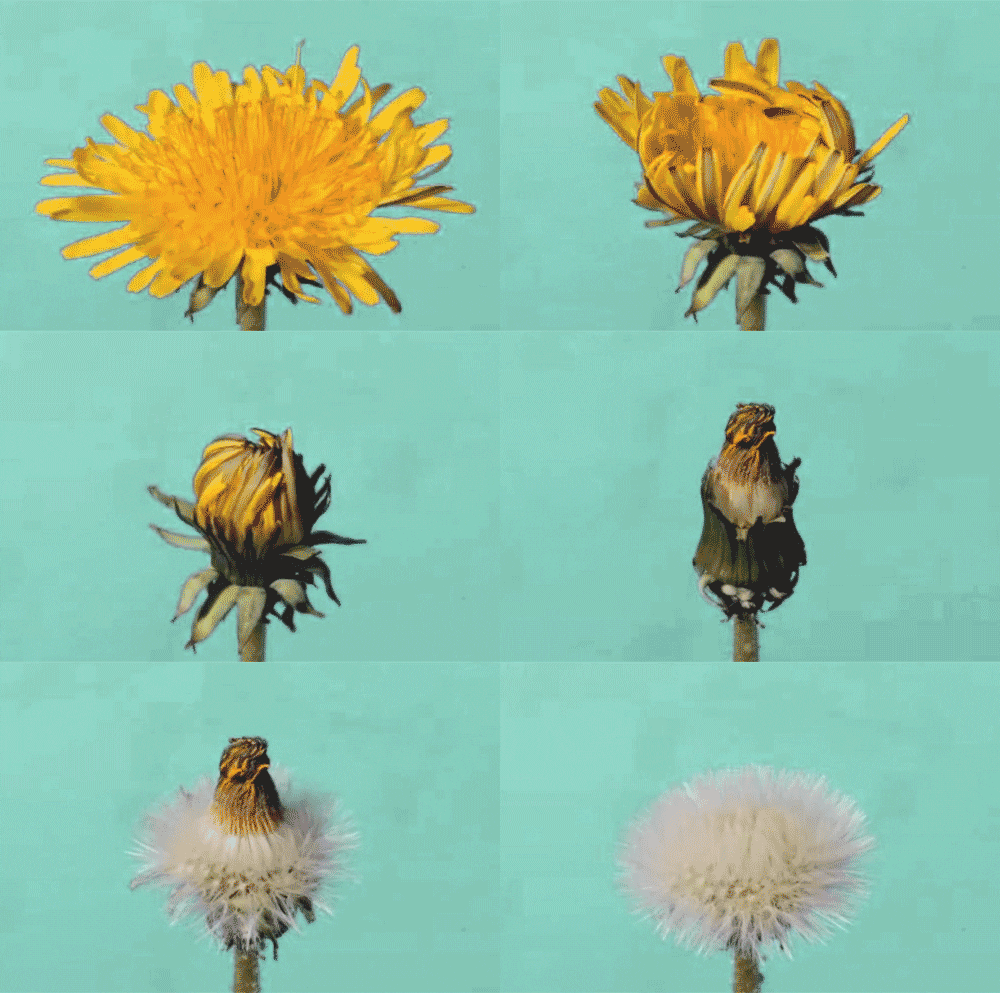

Cancer is one of those places where a lot of people have to think about their own mortality for the first time, a part of why I think it has such a significant place in the cultural conscience.  Everyone's first understanding of death is uniquely their own (a pet, a grandparent, or whatever else), but there is a common thread of humanity that grows out of it.  Our temporality is what makes so many things worthwhile, knowing that time is limited gives us push and motivation to do a number of things even subconsciously.  

I can hazard a guess at what they might have been feeling, but I certainly won't claim to know for surety.  This individual was old enough that they had likely experienced death and loss before, enough to have an understanding.  However, there' something very different in facing one's own mortality.  We have some feelings of empathy as we start to learn and apply the concept of death, yet my experience is that it's a wholly different beast when it is applied to oneself.  My guess is that this individual was processing some in the background but mostly seeking to reassure their loved ones, to keep them from worrying.  They also talked about their faith in no uncertain terms, which was a great source of comfort.  I feel this was probably a mix of both faith and bravado.  I do not discount their faith at all, but when there are that many platitudes flying around, I have to wonder if they're covering for or preventing genuine processing.  

It happened that I was able to run into this person again on another clinical day.  The feeling in the room was very different.  There had been some complications--they were exhausted, hurting, and feeling at least a little miserable.  That doesn't mean that faith was any less strong, but they were discouraged in that moment.  It hurt my heart to see that change, from the vibrancy to that ominous quiet.  I took some time to ask them about a project they had told me about the first time, something that was near and dear to them.  We walked in the hallway.  There was a minor procedure that I volunteered to help with, partly to spend some additional time in that room; I lingered specifically, just to be present.  And there were a couple of flashes of a true smile and other times where quiet companionship was more important.

That place was familiar, too.  I've circled the drain a couple of times before--there is an interesting point when one realizes "oh, this might actually be it."  I distinctly remember thinking that I didn't care how it was over anymore, whether I got better or died, just so long as it was over.  And I was okay with that in the moment.  There would be more processing and grief to work through later--still is--but I remember that moment with clinical detachment.  It was a simple fact.  Death was okay.  Death is a thing that is.  In my experience of that circling the drain moment, I opted not to accelerate death's timeline, but I wasn't going to deny it either and that was a heavy thing to process later.  And there was peace in letting that go, in simply waiting and not demanding one outcome or the other.  That's what the final threads felt like to me.  

I don't think this patient was that far--there was a lot yet that we could do and try for them--but I think they had a growing awareness that some of those places existed.  Or maybe I am projecting far too much on them.  But I had to think again on my own thoughts and opinions of death, how I got to those conclusions, and whether those ideas needed additional scrutiny by seeing components through another person's eyes.  I did a fair bit of listening that day and plenty of my own thinking.  

We don't know how to talk about death in our culture very well.  Persons that need to talk about it can be brushed off and hurt when they don't feel heard--think about a family member that refuses to talk about a particular family member dying, who refuses to acknowledge it let alone discuss funeral arrangements and last wishes in advance.  On the one hand, I get that it's upsetting; on the other, I've seen it directly hurt someone and heard plenty of stories where not having the discussion when there was a chance has led to some serious issue with the surviving family, both on the pastoral and medical side of the conversation.  I feel strongly that there is more harm in not talking about death, that there is a significant disservice in brushing those discussions off until they are forced upon you.  

Death is a driving force that makes us human.  Remembering that there is a lack of permanency gives me far more encouragement than it does dread.  There is hope in that.  I can direct pieces of that motivation.  I have power to do things today and a finite amount of time to consider what is and is not important to me.  While I don't look forward to losing a loved one or the dying process, I do not fear death itself.  

Hell of a proclamation, maybe, and concerning, too, to folks that might feel I have clearly thought about death too much, yet there we have it.  Not talking about death has not helped us--there are a number of different defense mechanism that we can utilize to help us through some of the more uncomfortable parts.  Personally, I prefer humor, and I daresay that it's a common thread in the medical world to develop a dark sense of humor as part of that coping.  That is the only way some folks CAN talk about it, as a punchline, but we can't always stay there.  Sometimes, a bit more reflection in chewable pieces makes the reality of it a bit easier to swallow.

Tuesday, April 20, 2021

Tempering

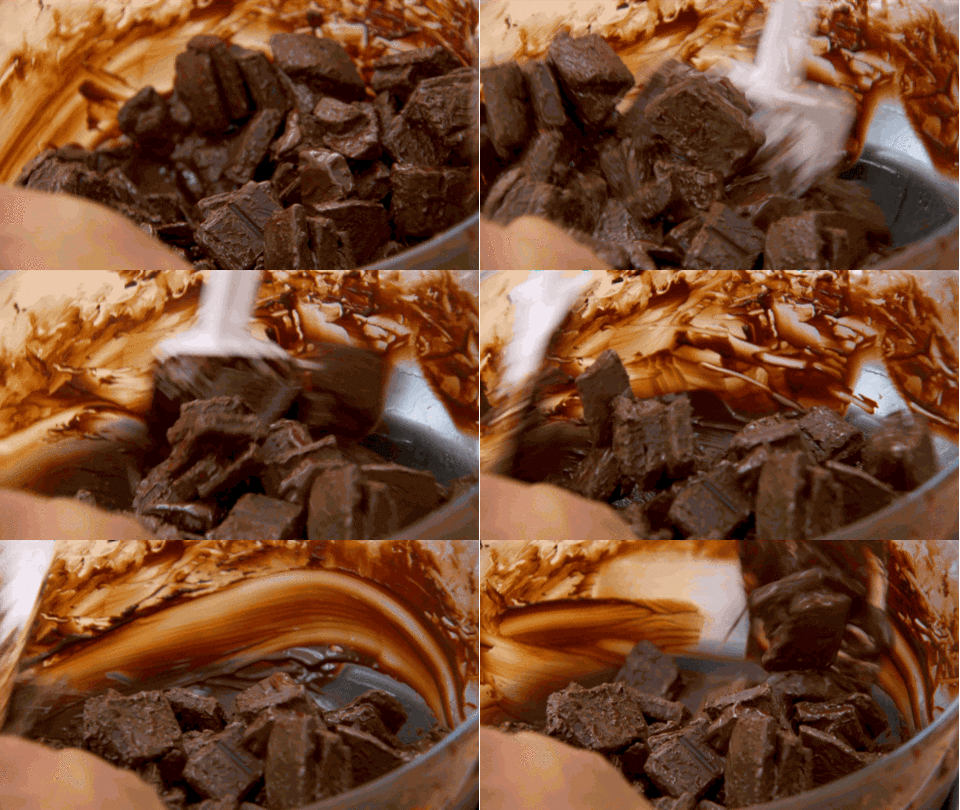
Watching the Great British Bake Off is a delight.  I've learned random things about cakes and other confectionaries that I never thought to ask, including that chocolate day ALWAYS happens on warm afternoons.  Speaking of chocolate, I was ruminating on the tempering process the other day.  

According to Alton Brown, the process of tempering chocolate is reorganizing the molecules in order to create a cleaner snap, stand better against melting, and have a lovely glossy finish.  It requires specific heat, and it requires vigorous mixing.  

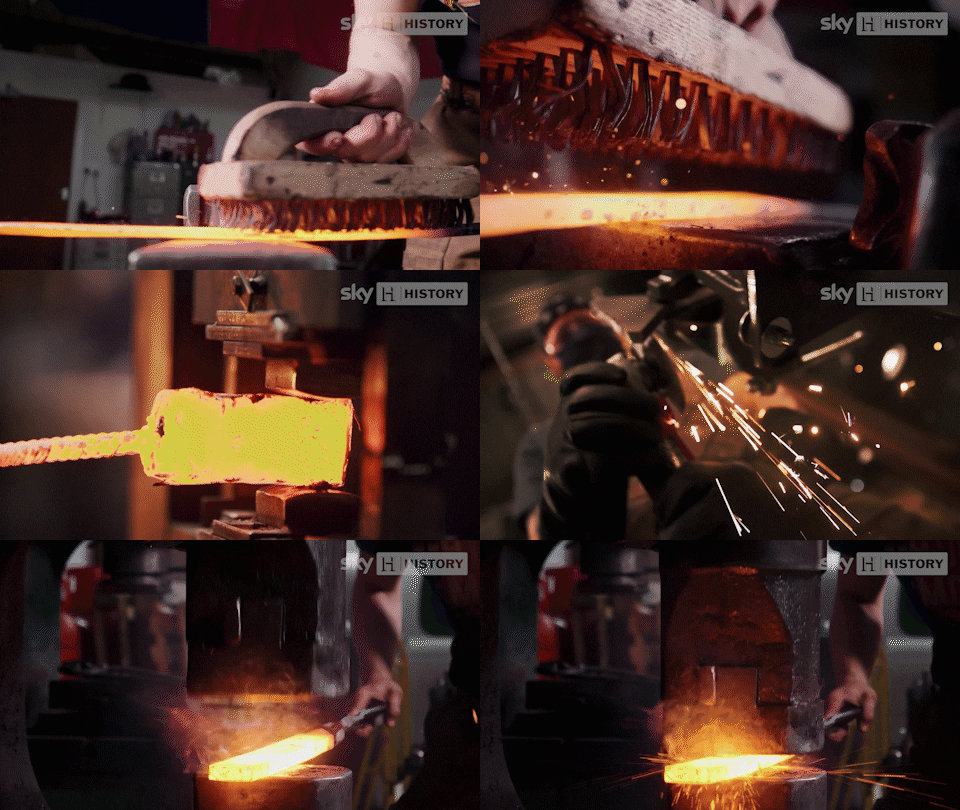
This isn't the only context that the word comes up.  It is also used in the context of forging, treating the steel with heat to help strengthen the material.  This helps the finished project to be more consistent, to keep the finished project from having brittle pieces.  The process involves high heat, specific cooling techniques, and no small amount of patience.
Intention and heat, all in the goal to alter the final product at the molecular level to add stability, consistency, and strength.  

The program has provided foundation, knowledge, resources; my own skillset lends communication skills and some specific experiences.  But I require tempering.  I need experience in order to solidify into the best nurse I can be, to find and remove the brittle areas before they have a chance to snap under pressure later.  Clinicals are meant to help with that.  Orientation days are meant to help with this.  Working with a mentor is meant to help with this.  And yet, spending time with patients and actually performing the job will be what helps temper best, to have practical experiences that vivify the book examples or become that weird situation that I will know how to manage better next time.  How will I deal with a racist patient, for example, or a violent one?  How will I cope with a patient that wants to leave even though it's against their best interests?  Or the family member who makes the hospital stay about them?  How will I deal with a peer that does not honor someone's gender identity?  Or even to simply command my own "normal" day?

Intentionality, time, and exposure.  Patience to manage the heat.  Humility to process the data.  Directed energy to new growth.  

Tuesday, April 13, 2021

Peterson Family Update #82969 Epsilon

Things are a weird kind of everything right now, where thoughts are rolling in different directions which means that it is time once again to deploy the bulleted list!

  • I've been trying to teach Luna a new trick:  for "roll over," I'm telling her "Do a barrel roll."  It's involved physically rolling a very confused pup many, many times, but now she will do it about 90% on her own power.  The remaining 10% is that I have to lead her head over her own body and sometimes nudge her when she gets a little stuck.  I'm planning my next trick already, trying to sort out how to break it into better increments.  I'm having fun doing it; she seems to appreciate the intellectual stimulation...but mostly the cheese.
  • I am trying a new gardening strategy.  It is "do better at not murdering the plants."  Specifically, I have been given a total of three bonsai trees.  I have killed two of them and seem to be on my way for a third.  The cool pot that I had moved it into, it had no drainage.  And quite a few weeks later, I realized the color was off and tried to water it more consistently, probably exacerbating the everything.  When we went to check it, branches snapped off in my hand.  It has since been trimmed, repotted, and we'll see what happens next.
  • In that vein of everything, one of my favorite things about this house is the magnolia tree--it's gorgeous this week.
  • Training for the new job starts tonight at Carle!  I've gone through fingerprinting, drug screening, a physical, handed over my immunization records, and I successfully have both nurse tech training and my first three shifts as a nurse tech sorted out.  The plan is to work as a CNA until my nursing boards are squared away and then go through orientation pieces for my RN duties.  It's feeling quite and very real now.  
  • I have been preparing all of March to get ahead and lighten the load of April.  And I'm glad to say that I have been successful in that endeavor, much to my own confusion.  I mean it is logical that I'm reaping the benefits of my efforts, but it's difficult to switch gears, after being pedal to the metal for so long.  So, I'm catching up on TV series while still trying to figure out what I must have forgotten to do that day.  Or I'm reading a fun book wondering if I'm missed a textbook chapter.  Changing pace is difficult.  There's also some general confusion in seeing the results of my hard work.  I know that sounds weird, but the goal of "find work as a nurse" has been something that I was working on for years, between researching, debt reduction, saving, and prerequisite coursework.
  • Andy has been branching into some streaming lately!  You can watch streams (live and past) on Twitch or edited on YouTube.  He's been streaming Fire Emblem, Monster Hunter, and the Donkey Kong Country titles.  One of my favorite things is to hear the panic squawking.
And that's the short of it.  More adventures and hijinks sure to come.  

Tuesday, April 6, 2021

Hope and False Hope

In one of my clinicals, there was a patient that had been in the hospital for a while.  Most of the nurses on the floor had had them as a patient on one shift or another and I caught the report from the one nurse to the oncoming nurse regarding this patient.  There was a moment of grief for this individual, that they were going through a rough time and were still in for a difficult recovery.  I had already interacted with this individual earlier in the day, ignorant of the full complexity of this history.  

I took a moment to reflect back on my actual experience with the patient earlier that day, with this additional information from the seasoned nurses.  Did I say anything that was flippant about the patient's situation to the patient?  Did I give false hope anywhere it wasn't warranted?  Did I explain elements of their care that they already knew fully but were just too polite to say something?  


I worry about that hope one more than anything.  Hope is as necessary as it is dangerous.  Normally, I can supply this for myself when I need it, but there are times when I have to work up to it, to help process what I need to.  I've had people try to give me hope when I wasn't ready to accept it, using it to slap a smiley sticker over a gaping wound that I needed to process.  That first major stint at Mayos, when my surgery failed, I kept a lot of my emotions in check (*cough* more like buried *cough cough*) and remained upbeat on the surface, focusing on the work that needed to be done:  I remember my cracking point.  

Vancomycin is a powerful antibiotic.  Thing is, your kidneys can only take so much of it, not to mention the other stresses my poor kidneys were also working through.  They were shutting down.  As evidence, I had some SERIOUS positional edema with legs like tree trunks and a very obvious difference in which side of my body was angled lower last.  We were starting to float the idea of dialysis.  In the midst of this, we were starting to at least discuss when I might be going home.  Finally.  We had a day lined up, started sharing the news and making plans, and the poor kidney specialist came in to tell me my creatinine was too high and I couldn't leave.  

I shattered.  The tenuous control was ripped away, and I had a damn cathartic cry, much to the horror of said specialist (who, at this teaching hospital had only just been given my case early in their new rotation, no less).  

It wouldn't have hurt so damn much, though, if I hadn't finally considered something larger to hope for other than my default for that month of "maybe tomorrow will be better."  

[Bonus sidebar:  there was an incident after that still enrages me to this day, where one of the new doctors that rotated in came into my room with a mock pouty-face and said "I hear someone's having a bad day."  As a reminder I A) was 25 and B) had been in and out of the ICU for a month at this point.  In therapy, I have reimagined telling him to fuck right off--it helps a bit.]

So, where's the line between false hope and actual hope?  Where's the line between what's possible and what's likely?  Where's the line between helpful hope and hurtful hope?  And how can I ensure that my patient gets the kind that they need in that moment?

I don't know.  So in lieu of an answer, I want to offer less smiley face stickers and more listening.  There are enough other people around to help throw in some platitudes that I certainly don't have to add those into the mix.  I can offer my personal experience--particularly regarding a full, articulate experience of living with an ostomy--but I also don't want to cover pieces where the patient needs to find their own expression.  AT THE SAME TIME, I want my patients that do need hope to see it reflected in me, to voice those places where things may be rough in this moment but are not a permanent hindrance on their life.  

...yeah, this is going to take some specific intentionality again.

Tuesday, March 30, 2021

Book Hangovers

 So, there's this particular feeling I've been working through lately, and honestly, the best way that I can think to explain it is like a book hangover.

What's a book hangover?  Great question.  Glad I pretended you asked.

No, it's not an official official term.  But picture this:  you've been thoroughly enjoying a book or maybe a streaming a tv series.  You've been waiting for a spot in your day--all day!--where you can read/watch just a little bit more.  Folks suggest plans after work and while you might be happy to join them, you also really just want to get back to your book/series.  Maybe you stayed up past one in the morning for just one more chapter/episode.  There's an excitement and a drive and you very much have something to look forward to.

...And then you reach the end.  All of that energy suddenly has no where to go, and it seems to fade into a disappointment of sorts.  There are no more chapters, no more episodes.  Even if it's a book in a series or there are more seasons or spinoffs, there tends to be a wall eventually.  There isn't something to look forward to in the same way.  The ending might have been **perfect** but the depression is still the same.  

Sometimes, it's easy to find the next thing to start on; other times it takes a while, wandering unattached and listless through the day, without that clear default or direction.  

Here's where that information comes into play:  I have been working for literal years now to prepare for nursing school, get into nursing school, dedicate my energy to learning in nursing school all in the goal to land a job as a practicing nurse.  I now have a job lined up for after nursing school, part of it starting up during the remainder of nursing school, actually.  I've been working through paperwork, fingerprinting, scheduling a physical, government forms, getting my employee picture taken, etc., and barring unforeseen disasters, it's real.  And I'm excited.

But I also feel a bit untethered at the moment.  The drive I had suddenly doesn't have the same direction and urgency as before.  The goal is altered a bit; I need to find my refocus.  There are certainly still things left to do--remaining clinicals and course material for this term, completing the final term, passing the NCLEX--but it feels different with the clarity of that next step.  The push to get an A in remaining courses is not as important, for example, as ensuring that I am prepared for the NCLEX itself, which in turn will dictate how I allocate my study time.  And even after that, the push to understand and apply the information in my courses is more important to said job than responses to first-level questions in courses, meaning that how I approach studying in itself will similarly shift.   

In short:  I am beginning to process and participate in the shift from theory into practice.  Furthermore, I recognize that it's uncomfortable to refocus and find new patterns in the same breath that I'm confident I will be able to find that next great drive of energy forward.  I have a quite few goals yet to do, including WOC certification and eventually writing a book about experiences in living with a stoma, as a resource for both patients and their families going through something similar.    

But in the meanwhile, I need to experience the recalibration.  

Tuesday, March 23, 2021

The Cream of Tartar Story

There are family stories that are passed down and around until they practically become mythology.  And then, there is a very specific jubilance when you realize that someone you're talking to has actually not yet heard that story.  

This is one of those.  And somehow I haven't already documented it here on the blog.

My dear Andy.  My sweet, wonderful Andy.  

We had been in our apartment for about a month or so, if memory serves.  I was working on making dinner one night, and I realized partway through that I was missing an ingredient for my chicken pot pie recipe, namely cream of tartar.  Out of the goodness of his heart, Andy offers to pop to the store and pick it up for me while I keep working on the filling.  

The grocery story, mind you, is less than three minutes down the road.  So I was a little bit confused why it took closer to twenty minutes for him to get back.

The door opens.  I call out some greeting, but immediately Andy bursts out with "Did you know that cream of tartar is not a soup?!"

I started to stammer that, yes, in fact I did know that but Andy was already on a roll:  "I found cream of tomato, cream of potato, cream of cheddar, cream of broccoli, I even checked the Progresso ones to see if it was just a weird one..."

At this point, I'm DYING and unable to hold in the laughs.  

"So I pulled open my phone and asked it 'Campbell's cream of tartar' and my phone basically looked at my like 'BUHRH?'  So I asked it for 'cream of tartar' and gave me potassium bitartrate and I scrolled down like 'no, NO, maybe? Okay,' and I went over to the baking aisle and it was RIGHT THERE in front!"  

It will never not be funny to me.  My folks took a label maker and "corrected" a cream of chicken can for Andy once that stayed on our stovetop as a decoration for along time.  Some folks will fess up that they wouldn't have known that either, might even have tried the dairy section; others immediately shake their heads with that indulgent but disbelieving headshake.  

Of course, I had set a potato bag on fire a few weeks prior, and Andy hadn't let me forget that either.  And at this home, Mike and I were greatly intimidated by the pilot light of the water heater ("I don't smell gas; I just feel fear!"), which is also the stuff of family mythologies.  They're those kinds of stories that hold us closer.  

Tuesday, March 16, 2021

Attunement

Sometimes when Andy and I are working together in the kitchen, I can point toward the counter and he will automatically hand me the next piece I need for whatever it is I'm working on, never breaking in the conversation between us.  Other times, we have had entire conversations in sleepy, morning grunts.  Sometimes, we are planning something out for the house and entirely on the same wavelength, making the same cognitive jumps and building off of one another's ideas to make a wonderfully cohesive plan.

And other times I have to ask four times what "it" is in the sentence.  Or we find out fifteen frustrated minutes later that there was a misunderstanding about the timeline of what we were discussing, which was resulting in a much more barbed conversation than expected.  Or the response to the question included a heavy sigh because there was an implied secondary task with the first that hadn't actually been implied but was somehow there all the same.


It happens.  That synchronicity ebbs and flows.  Some days we're remarkably attuned to the others' needs.  Other days we feel disconnected, needing to find where the roadblock is but knowing that this is going to take some emotional energy that we might not have at the moment.  And to add insult to injury, we're frustrated that we're out of attunement already, not even starting on the whatever the core issue is.

It's okay to let ourselves feel that way, to mourn the moments of disconnect.  It hurts.  When both of us are ready to, we can find walk along the riverbank to find where it's blocked.  We can find that space to meet in the middle again.  We can realign.  It takes time and energy, but it restores communication, that instead of a trickle we're an efficient flow that makes all else smoother.  It takes intentionality.  

I've been thinking about this in some different ways during the pandemic.  A whole year under these new uncertainties.  I think about friendships that I long to reconnect; I chastise myself for not always having the emotional energy to act on bettering them now.  I'm grateful for persons who have reached out to me; I'm grateful to those that have responded when I can reach out.  I take time to find a middle and how far I am able to stretch at a given moment.  I wonder at what attunement needs repair that I haven't even realized.  

And I marvel at the group of persons that I have cultivated into my life, both those that will transition out and those that will stay.