- That particular kind of tired when you've been on your feet and moving for twelve hours.
- The kind of tired from waking up after a depression nap somehow more tired than before.
- The feeling of running on empty for too many weeks in a row.
- Being "peopled out."
- Feeling unappreciated.
- Waiting to have an uncomfortable conversation with someone.
- When your brain is exhausted.
- The straight-up bad night of sleep.
- My dreams were too "busy" last night.
- Company politics are being stupid again.
- National politics are being stupid again.
- Active waiting or hoping.
- Something interrupted rest and there was no returning in a timely manner.
- When you've given more emotion than you had.
- When everything is everything all at once.
- When you realize you haven't allowed yourself to be still in far too long.
- Having done absolutely nothing productive all day.
- Having done absolutely nothing productive all day and feeling guilty about it.
- Anticipatory tired.
- When your heart full.
- Exhaustion by a thousand cuts.
- The satisfying workout.
- Waking up on a rainy morning.
- "Ordinary" physical exhaustion.
- The "I didn't even realize I was this exhausted," sneaky tired.
- Tired because of a flash of anger.
- The particular space where you would like a short pause from existing just for a couple hours.
- That feeling when pausing to assess or relax somehow makes you feel more tired.
- The space where you do want to do anything in particular but you don't want to be doing nothing.
- When you want to write because you know it feels good to write and otherwise good to continue the habit but at the same time you cannot manage to find words together in any kind of sense because your brain doesn't feel like working that way today.
Tuesday, May 18, 2021
Kinds of Tired
Tuesday, May 4, 2021
Starting as a CNA
- Highlighters are hella useful, as I start to set up my own patterns for what I want to do in the day--specifically, my tasks as a CNA include vital signs, assisting to the bathroom (or cleaning up after), assisting with bathing and other hygiene activities, assisting with eating, changing the batteries on heart monitors, measuring blood sugar levels, and otherwise communicating with the nurse for other needs. Not everyone needs all of these tasks (aside from vital signs). So I spend the first few minutes gathering my bearings on who might need what over the course of the day. I don't have a complete system yet, so I'm starting to play with color coding, at least starting the day cleanly.
- My organization system usually collapses by 1300, as situations change or patients are either added or discharged. This is part of the process, rolling with the punches.
- Ingenuity is an essential skill. Need to cover someone's IV before they go into the shower? Find a plastic bag and some tape and get creative. Only able to find one "leg" for the wheelchair? Find another to steal or get creative. Confused, fall-risk patient not inclined to stay in bed? Have them help fold towels (and then refold after you accidently move them) or print out some crosswords or get creative. There isn't always a band-aid that fits perfectly; every patient is their own person; the situation is going to keep changing.
- I get a LOT of steps in on the day, moving from one piece to the next to the next, more even than my clinical days as a nurse. So far, I've left each of these days (twelve hour shifts, mind you) on the floor physically tired but spiritually very full.
- I'm ironing out parts of my script, trying to find what questions I should ask everyone in the first interaction to set the tone for my day. I've already given up the idea of trying to decide which patient I see first, because inevitably someone has already called for my assistance and they are now my starting point, often followed by another call as my second person, and otherwise fitting all of my other pieces in as I go until I've seen everyone.
- I delight in those moments where I can stop and listen to someone that clearly needs to feel heard. I can't do this all the time--sometimes my phone will not stop going off when I'm trying to help one patient to the bathroom, and I have three other rooms that have asked for my attention after that. But sometimes, there are spaces where I can linger and have those human moments. I cannot be all things to all people; but I will have the opportunity to be different things in some of those in-betweens. And in places where I cannot show empathy in a long listen, I can still set their arm down with a gentle touch and smile with meaning as I thank them for allowing me to take their temperature.
- On a different note, I swear I have sweat off about a pound so far working in some of the isolation rooms--in the plastic gown over my scrubs, incubating in my own heat with the added movement, it gets toasty quickly.
- Sometimes I forget about Melvin in the bustle of everything. And sometimes, Melvin helps me remember to stop, take care of the bag, pee, and get some water, just another small but insistent reminder to pause and tend to myself, too.
- I'm starting to network with some of my teammates--when I can grab something for one of the other techs or I follow-up with a nurse when I said I would do so, I'm establishing myself as part of the team a bit at a time and also making space for that reciprocity already and in the future. I feel that I'm contributing.
Tuesday, April 27, 2021
Mortality
So in my theory classes we were having a discussion and focus on end of life care. Within the next couple weeks, I had the pleasure of working with a patient that had newly been diagnosed with cancer in my clinicals.
That may not sound like a pleasure, but this person was. Honestly, there was a steady flood of calls and her designated visitor was attentive, so we did not have a lot of opportunity to talk over anything deep, other than her immediate needs and my immediate obligations to those needs. This individual was optimistic and vibrant, feeding as much support into her support network as she was receiving, from the look of it.
Cancer is one of those places where a lot of people have to think about their own mortality for the first time, a part of why I think it has such a significant place in the cultural conscience. Everyone's first understanding of death is uniquely their own (a pet, a grandparent, or whatever else), but there is a common thread of humanity that grows out of it. Our temporality is what makes so many things worthwhile, knowing that time is limited gives us push and motivation to do a number of things even subconsciously.
I can hazard a guess at what they might have been feeling, but I certainly won't claim to know for surety. This individual was old enough that they had likely experienced death and loss before, enough to have an understanding. However, there' something very different in facing one's own mortality. We have some feelings of empathy as we start to learn and apply the concept of death, yet my experience is that it's a wholly different beast when it is applied to oneself. My guess is that this individual was processing some in the background but mostly seeking to reassure their loved ones, to keep them from worrying. They also talked about their faith in no uncertain terms, which was a great source of comfort. I feel this was probably a mix of both faith and bravado. I do not discount their faith at all, but when there are that many platitudes flying around, I have to wonder if they're covering for or preventing genuine processing.
It happened that I was able to run into this person again on another clinical day. The feeling in the room was very different. There had been some complications--they were exhausted, hurting, and feeling at least a little miserable. That doesn't mean that faith was any less strong, but they were discouraged in that moment. It hurt my heart to see that change, from the vibrancy to that ominous quiet. I took some time to ask them about a project they had told me about the first time, something that was near and dear to them. We walked in the hallway. There was a minor procedure that I volunteered to help with, partly to spend some additional time in that room; I lingered specifically, just to be present. And there were a couple of flashes of a true smile and other times where quiet companionship was more important.
That place was familiar, too. I've circled the drain a couple of times before--there is an interesting point when one realizes "oh, this might actually be it." I distinctly remember thinking that I didn't care how it was over anymore, whether I got better or died, just so long as it was over. And I was okay with that in the moment. There would be more processing and grief to work through later--still is--but I remember that moment with clinical detachment. It was a simple fact. Death was okay. Death is a thing that is. In my experience of that circling the drain moment, I opted not to accelerate death's timeline, but I wasn't going to deny it either and that was a heavy thing to process later. And there was peace in letting that go, in simply waiting and not demanding one outcome or the other. That's what the final threads felt like to me.
I don't think this patient was that far--there was a lot yet that we could do and try for them--but I think they had a growing awareness that some of those places existed. Or maybe I am projecting far too much on them. But I had to think again on my own thoughts and opinions of death, how I got to those conclusions, and whether those ideas needed additional scrutiny by seeing components through another person's eyes. I did a fair bit of listening that day and plenty of my own thinking.
We don't know how to talk about death in our culture very well. Persons that need to talk about it can be brushed off and hurt when they don't feel heard--think about a family member that refuses to talk about a particular family member dying, who refuses to acknowledge it let alone discuss funeral arrangements and last wishes in advance. On the one hand, I get that it's upsetting; on the other, I've seen it directly hurt someone and heard plenty of stories where not having the discussion when there was a chance has led to some serious issue with the surviving family, both on the pastoral and medical side of the conversation. I feel strongly that there is more harm in not talking about death, that there is a significant disservice in brushing those discussions off until they are forced upon you.
Death is a driving force that makes us human. Remembering that there is a lack of permanency gives me far more encouragement than it does dread. There is hope in that. I can direct pieces of that motivation. I have power to do things today and a finite amount of time to consider what is and is not important to me. While I don't look forward to losing a loved one or the dying process, I do not fear death itself.
Hell of a proclamation, maybe, and concerning, too, to folks that might feel I have clearly thought about death too much, yet there we have it. Not talking about death has not helped us--there are a number of different defense mechanism that we can utilize to help us through some of the more uncomfortable parts. Personally, I prefer humor, and I daresay that it's a common thread in the medical world to develop a dark sense of humor as part of that coping. That is the only way some folks CAN talk about it, as a punchline, but we can't always stay there. Sometimes, a bit more reflection in chewable pieces makes the reality of it a bit easier to swallow.
Tuesday, April 20, 2021
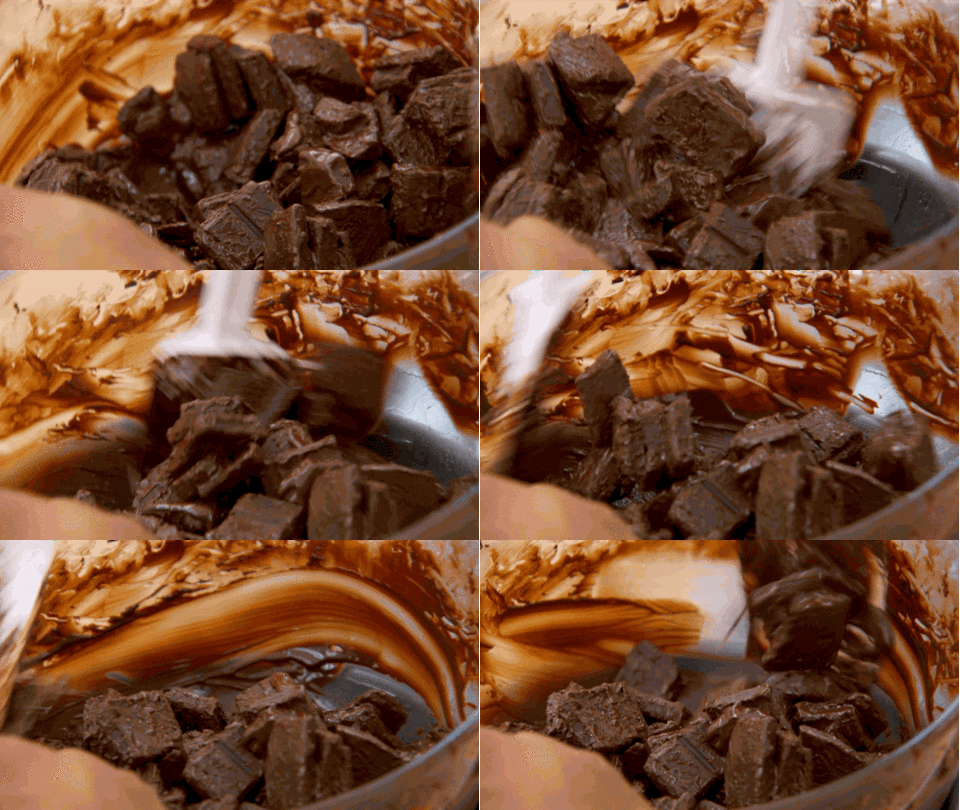
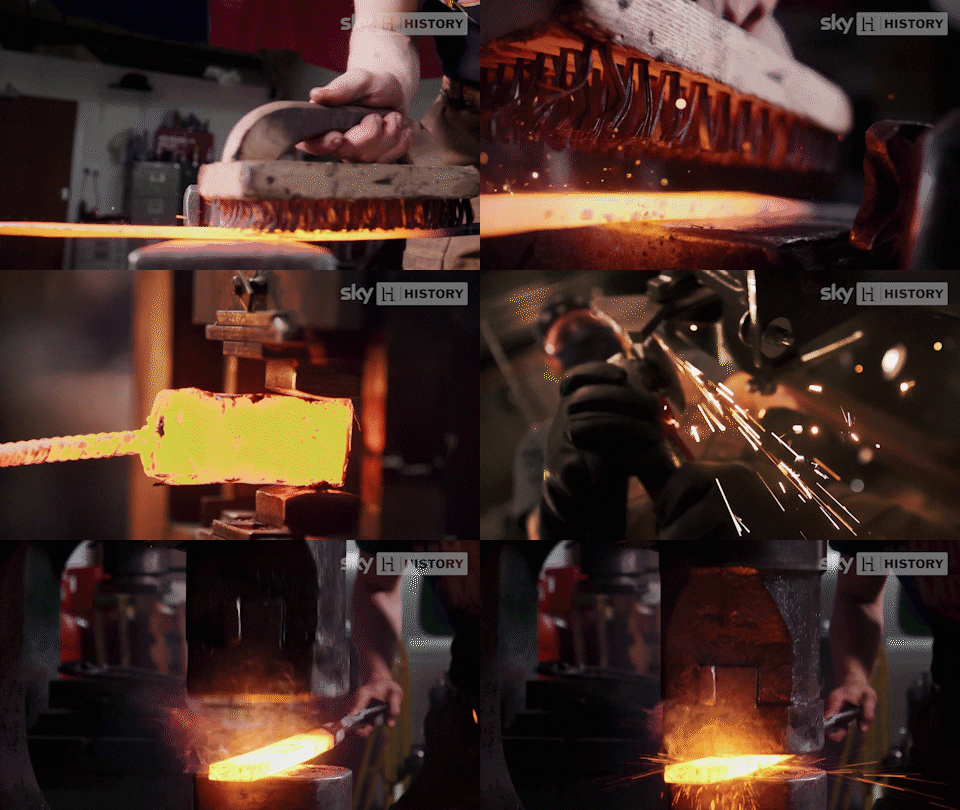
Tempering
Tuesday, April 13, 2021
Peterson Family Update #82969 Epsilon
Things are a weird kind of everything right now, where thoughts are rolling in different directions which means that it is time once again to deploy the bulleted list!
- I've been trying to teach Luna a new trick: for "roll over," I'm telling her "Do a barrel roll." It's involved physically rolling a very confused pup many, many times, but now she will do it about 90% on her own power. The remaining 10% is that I have to lead her head over her own body and sometimes nudge her when she gets a little stuck. I'm planning my next trick already, trying to sort out how to break it into better increments. I'm having fun doing it; she seems to appreciate the intellectual stimulation...but mostly the cheese.
- I am trying a new gardening strategy. It is "do better at not murdering the plants." Specifically, I have been given a total of three bonsai trees. I have killed two of them and seem to be on my way for a third. The cool pot that I had moved it into, it had no drainage. And quite a few weeks later, I realized the color was off and tried to water it more consistently, probably exacerbating the everything. When we went to check it, branches snapped off in my hand. It has since been trimmed, repotted, and we'll see what happens next.
- In that vein of everything, one of my favorite things about this house is the magnolia tree--it's gorgeous this week.
- Training for the new job starts tonight at Carle! I've gone through fingerprinting, drug screening, a physical, handed over my immunization records, and I successfully have both nurse tech training and my first three shifts as a nurse tech sorted out. The plan is to work as a CNA until my nursing boards are squared away and then go through orientation pieces for my RN duties. It's feeling quite and very real now.
- I have been preparing all of March to get ahead and lighten the load of April. And I'm glad to say that I have been successful in that endeavor, much to my own confusion. I mean it is logical that I'm reaping the benefits of my efforts, but it's difficult to switch gears, after being pedal to the metal for so long. So, I'm catching up on TV series while still trying to figure out what I must have forgotten to do that day. Or I'm reading a fun book wondering if I'm missed a textbook chapter. Changing pace is difficult. There's also some general confusion in seeing the results of my hard work. I know that sounds weird, but the goal of "find work as a nurse" has been something that I was working on for years, between researching, debt reduction, saving, and prerequisite coursework.
- Andy has been branching into some streaming lately! You can watch streams (live and past) on Twitch or edited on YouTube. He's been streaming Fire Emblem, Monster Hunter, and the Donkey Kong Country titles. One of my favorite things is to hear the panic squawking.
Tuesday, April 6, 2021
Hope and False Hope
In one of my clinicals, there was a patient that had been in the hospital for a while. Most of the nurses on the floor had had them as a patient on one shift or another and I caught the report from the one nurse to the oncoming nurse regarding this patient. There was a moment of grief for this individual, that they were going through a rough time and were still in for a difficult recovery. I had already interacted with this individual earlier in the day, ignorant of the full complexity of this history.
I took a moment to reflect back on my actual experience with the patient earlier that day, with this additional information from the seasoned nurses. Did I say anything that was flippant about the patient's situation to the patient? Did I give false hope anywhere it wasn't warranted? Did I explain elements of their care that they already knew fully but were just too polite to say something?
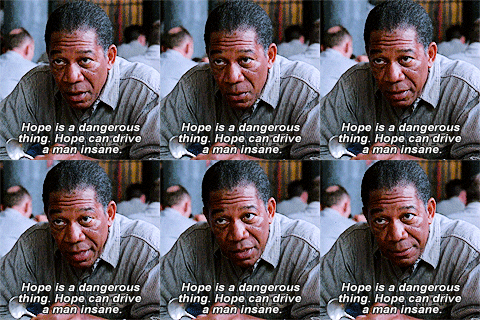
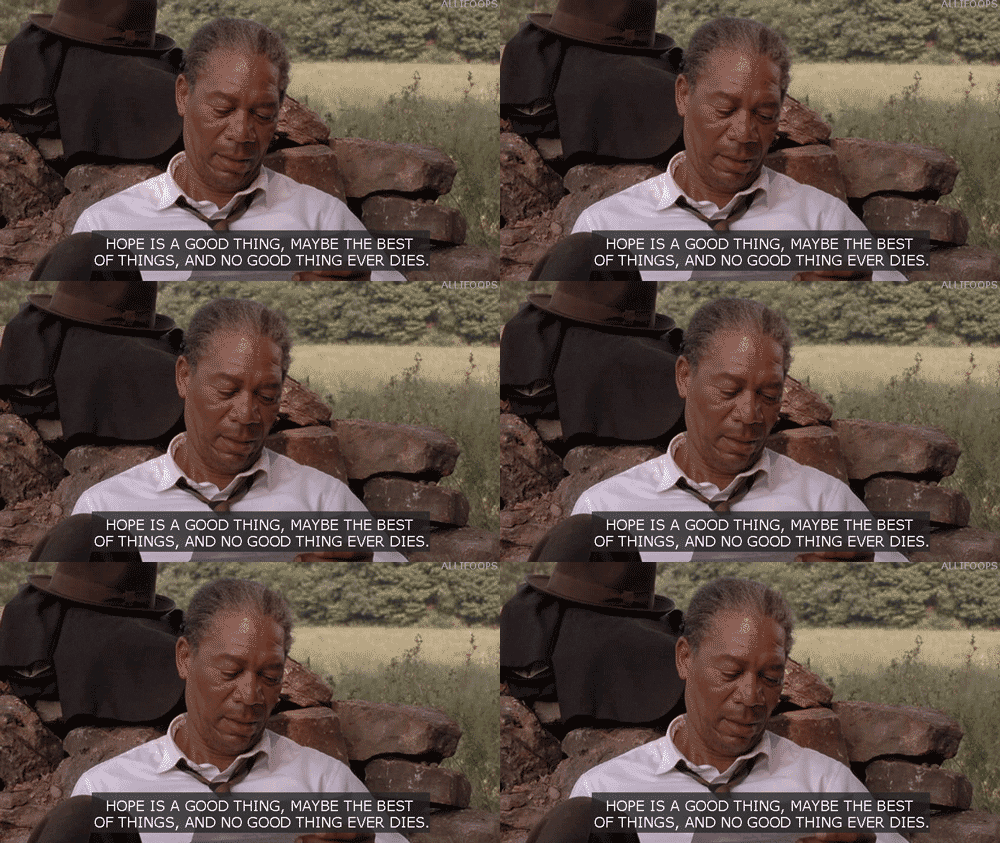
I worry about that hope one more than anything. Hope is as necessary as it is dangerous. Normally, I can supply this for myself when I need it, but there are times when I have to work up to it, to help process what I need to. I've had people try to give me hope when I wasn't ready to accept it, using it to slap a smiley sticker over a gaping wound that I needed to process. That first major stint at Mayos, when my surgery failed, I kept a lot of my emotions in check (*cough* more like buried *cough cough*) and remained upbeat on the surface, focusing on the work that needed to be done: I remember my cracking point.
Vancomycin is a powerful antibiotic. Thing is, your kidneys can only take so much of it, not to mention the other stresses my poor kidneys were also working through. They were shutting down. As evidence, I had some SERIOUS positional edema with legs like tree trunks and a very obvious difference in which side of my body was angled lower last. We were starting to float the idea of dialysis. In the midst of this, we were starting to at least discuss when I might be going home. Finally. We had a day lined up, started sharing the news and making plans, and the poor kidney specialist came in to tell me my creatinine was too high and I couldn't leave.
I shattered. The tenuous control was ripped away, and I had a damn cathartic cry, much to the horror of said specialist (who, at this teaching hospital had only just been given my case early in their new rotation, no less).
It wouldn't have hurt so damn much, though, if I hadn't finally considered something larger to hope for other than my default for that month of "maybe tomorrow will be better."
[Bonus sidebar: there was an incident after that still enrages me to this day, where one of the new doctors that rotated in came into my room with a mock pouty-face and said "I hear someone's having a bad day." As a reminder I A) was 25 and B) had been in and out of the ICU for a month at this point. In therapy, I have reimagined telling him to fuck right off--it helps a bit.]
So, where's the line between false hope and actual hope? Where's the line between what's possible and what's likely? Where's the line between helpful hope and hurtful hope? And how can I ensure that my patient gets the kind that they need in that moment?
I don't know. So in lieu of an answer, I want to offer less smiley face stickers and more listening. There are enough other people around to help throw in some platitudes that I certainly don't have to add those into the mix. I can offer my personal experience--particularly regarding a full, articulate experience of living with an ostomy--but I also don't want to cover pieces where the patient needs to find their own expression. AT THE SAME TIME, I want my patients that do need hope to see it reflected in me, to voice those places where things may be rough in this moment but are not a permanent hindrance on their life.
...yeah, this is going to take some specific intentionality again.
Tuesday, March 30, 2021
Book Hangovers
So, there's this particular feeling I've been working through lately, and honestly, the best way that I can think to explain it is like a book hangover.
What's a book hangover? Great question. Glad I pretended you asked.
No, it's not an official official term. But picture this: you've been thoroughly enjoying a book or maybe a streaming a tv series. You've been waiting for a spot in your day--all day!--where you can read/watch just a little bit more. Folks suggest plans after work and while you might be happy to join them, you also really just want to get back to your book/series. Maybe you stayed up past one in the morning for just one more chapter/episode. There's an excitement and a drive and you very much have something to look forward to.